German Yeast Cake with Quark and Raisins (Quark-Streuselkuchen) Recipe
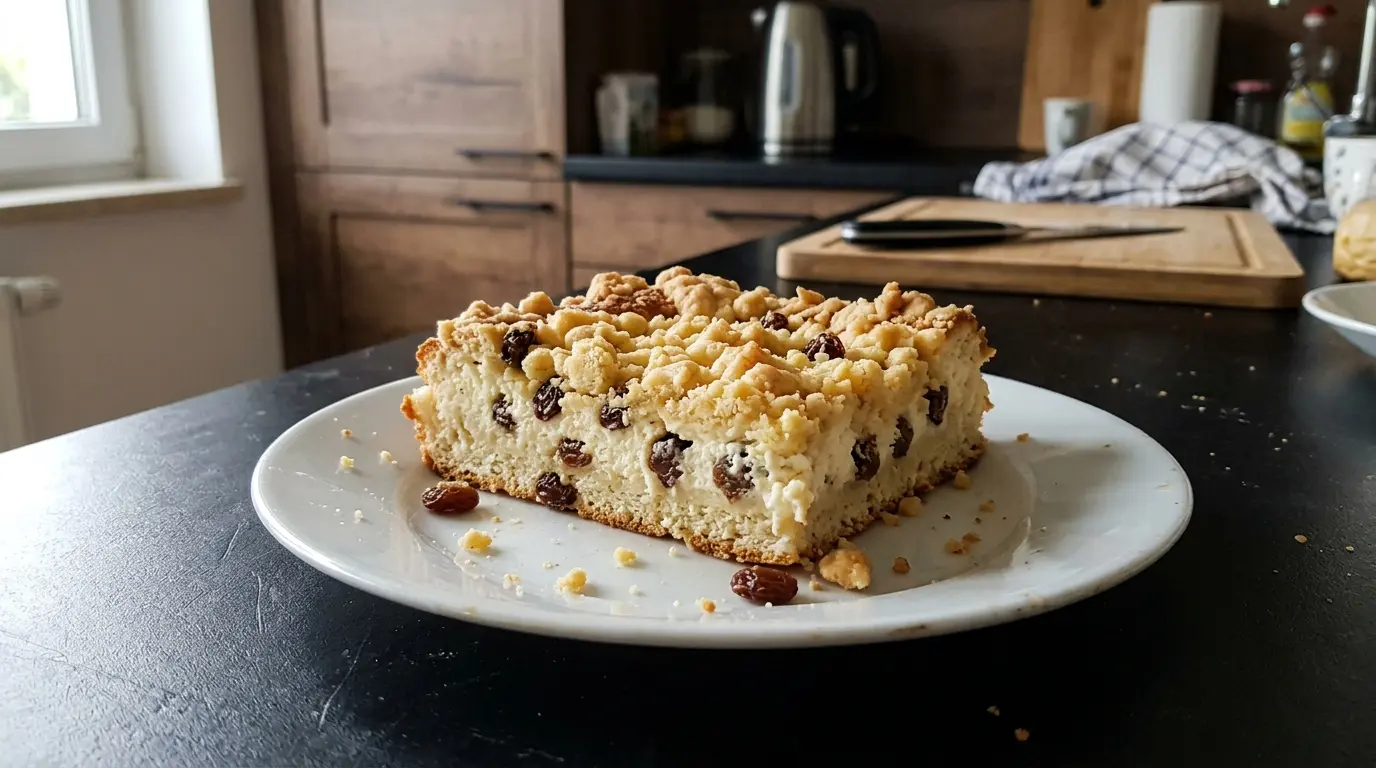
Quark-Streuselkuchen is a popular German cake with a yeast dough base, a thick layer of quark filling and a crunchy streusel topping. It often appears at Sunday “Kaffee und Kuchen”, the traditional afternoon coffee-and-cake time. The taste is like a cross between a cheesecake and a sweet yeast bun, so it’s hard to stop at just one piece.
Cakes like this with quark and streusel are a classic of German “Kaffeeklatsch” – relaxed afternoon coffee gatherings where the cake is cut into rectangles and served like sweet buns. In bakeries it’s often sold straight from large sheet pans by weight.
This cake combines three textures in one bite: soft yeast dough, creamy quark filling and crunchy streusel. It’s a classic of German home baking and perfect for sharing at coffee time or family gatherings.
Why this version works
- The thin yeast base highlights the thick quark layer, so the dessert is more like a cheesecake on yeast dough than an ordinary sweet bun.
- Instant pudding powder stabilises the quark filling so that once cooled it holds its shape and doesn’t ooze out when sliced.
- Streusel made with soft butter and chilled before baking keeps distinct, crunchy clumps instead of turning into one hard crust.
- Only briefly mixing the filling limits how much air gets in, so after baking the surface stays relatively flat with minimal cracking.
Chef's tips
Use quark that is as thick as possible so the filling sets nicely and doesn’t become watery. Make sure the milk for the yeast is only lukewarm, not hot, or the yeast may lose its strength. Don’t overmix the quark filling—blend just until smooth to keep it light.
How to serve
Serve the cake slightly chilled or at room temperature with freshly brewed coffee. It also pairs well with lightly sweetened whipped cream or a spoonful of fruit compote, such as sour cherries or stewed apples.
Watch out for
- Milk that is too hot can kill the yeast – it should feel pleasantly warm to the touch, not hot.
- Don’t add a lot of extra flour to the dough; a tough yeast base will overpower the delicate quark layer.
- Don’t beat the quark mixture for a long time or on high speed, otherwise it will rise too much in the oven and then collapse and crack.
- Don’t take the cake out of the tin while it’s hot – the warm quark layer is soft and can shift out of place.
Substitutions
- You can replace the raisins with dried cranberries or finely chopped dried apricots if you prefer a less sweet accent.
- Fresh yeast can be replaced with about 7 g of instant yeast added directly to the flour.
- You can replace up to half of the sugar in the streusel with brown sugar for a more caramel-like flavour.
- The cream in the quark layer can be swapped for thick natural yoghurt; the filling will be a little lighter.
Ingredients
- wheat flour divide into 250 g for the dough and 200 g for the streusel - 450 g
- milk lukewarm, not hot - 150 ml
- fresh yeast or 7 g instant dry yeast - 20 g
- sugar divide into 60 g for the dough, 80 g for the quark filling and 60 g for the streusel - 200 g
- butter soft; 80 g for the dough, 120 g for the streusel - 200 g
- egg 2 for the quark filling, 1 for the dough - 3 pieces
- semi-fat quark well drained or from a tub, but thick - 750 g
- cream 12–18% fat - 100 g
- vanilla pudding powder for 0.5 l milk, used as a thickener - 1 package
- raisins optionally soaked in warm water or juice - 80 g
- vanillin sugar 1 for the quark filling, 1 for the streusel - 2 packages
- salt a pinch for the dough and for the streusel - 0.5 teaspoons
Preparation
- Gently warm the milk – when you dip a finger in, it should feel distinctly warm but not hot. Crumble the yeast into a small bowl, add 1 tablespoon of sugar and a few tablespoons of the warm milk, mix and leave for 10 minutes, until a fluffy, clearly foamy layer appears on top.
- Put 250 g flour into a large bowl, add 0.5 teaspoon salt, 60 g sugar, 1 egg and 80 g soft butter. Pour in the foamy yeast mixture and knead for 5–7 minutes, until the dough is smooth, elastic, pulls away from the sides of the bowl and only slightly sticks to your hands.
- Cover the bowl with the dough with a cloth and leave in a warm, draught‑free place for about 40 minutes. The dough is ready when it has clearly doubled in volume and, when you gently press it with a finger, the indentation slowly fills in instead of springing back at once.
- Meanwhile, prepare the quark filling: put the quark, 2 eggs, 80 g sugar, 1 packet of vanillin sugar, the cream and the pudding powder into a bowl. Briefly mix on medium speed just until you have a smooth, uniform filling without lumps and without a lot of foam.
- If needed, rinse and dry the raisins; you can also soak them in juice or rum for 10–15 minutes. Add them to the quark filling and mix with a spoon so they are evenly distributed and don’t form clusters in one corner of the cake.
- For the streusel, put 200 g flour, 60 g sugar, 1 packet of vanillin sugar and a pinch of salt into a bowl, then add 120 g soft butter. Rub with your fingers until you get crumbs ranging in size from sand to small beans; the mixture should be loose but hold together when squeezed in your hand.
- Line a baking tray of about 30×40 cm with baking paper. Turn the risen dough out onto a lightly floured work surface, knead briefly to knock out the air, then roll out or stretch with your fingers to the size of the tray. Transfer to the tray and smooth it out so the layer has an even thickness with no thin patches.
- Pour the quark filling over the yeast base and spread it all the way to the edges, smoothing the top with a spatula so it is level and without hollows. Sprinkle evenly with the streusel, leaving distinct clumps and without pressing them into the filling.
- Leave the cake to rise for another 10–15 minutes so it can puff slightly; during this time the streusel will lightly “adhere”. Preheat the oven to 180°C, top and bottom heat, then place the tray inside and bake for 30–35 minutes, until the streusel is golden and the centre is set but springy when you gently shake the tray.
- After baking, take the cake out and leave it in the tin for at least 1–2 hours, until it has completely cooled and the centre feels cool to the touch. Only then cut it into rectangles – the quark layer will stay in place and the edges of the pieces will be neat.
Storage
Store leftover cake covered in the fridge for up to 3 days. For the best texture, let the slice sit at room temperature for a short while before serving, or briefly warm it in a low oven to refresh the streusel.
This Quark-Streuselkuchen reminds me of German Sunday afternoons, when the whole family gathers around the table for coffee and cake. The combination of yeast dough and quark is both comforting and a bit nostalgic, and the crunchy streusel on top makes it irresistible.