No-Bake Cheesecake with Curd Cheese and Jelly Recipe
No-bake cheesecake is a summer hit of Polish balconies and gardens – cool, light and colorful thanks to fruit and jelly. It doesn’t require baking, so it’s perfect when you don’t want to heat up the kitchen with the oven. It’s a dessert that often appears at name-day parties and family gatherings, because you can prepare it the day before.
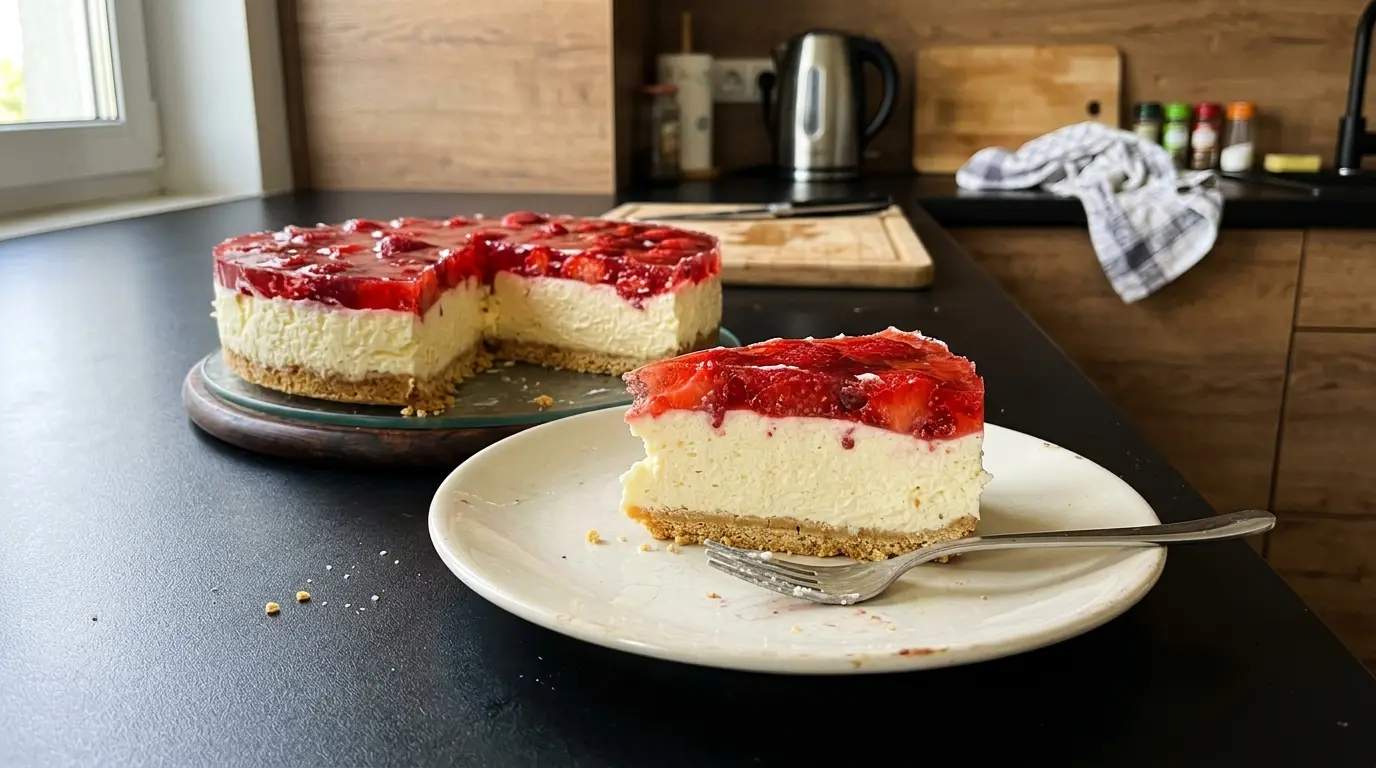
No-bake cheesecake with curd cheese and jelly is a summer classic of Polish balconies and gardens – cool, slightly tangy from the lemon and pleasantly creamy. The combination of a biscuit base, delicate cheesecake layer and colorful jelly with fruit creates a dessert that looks impressive yet isn’t as heavy as baked cheesecake. It’s an ideal way to use fresh seasonal fruit without heating up the kitchen with the oven.
Chef's tips
The key is to dissolve the gelatin properly – lumps in the cheesecake mixture are a classic mishap, so I always mix it first with a few spoonfuls of cheese and only then pour it into the rest. The curd cheese should be smooth, ideally triple-ground or well blended, otherwise the mixture will be grainy. Pour the jelly when it is already cool and slightly thickening; otherwise it may soak into the cheesecake and create unattractive streaks.
How to serve
Serve it well chilled on a hot day on the balcony, with a jug of water with mint and lemon – dessert and refreshment in one. For a name-day celebration it looks great in the center of the table, decorated with fresh fruit in colors matching the jelly. You can also cut it into small cubes and serve on a platter at a garden party as finger food with prosecco.
Ingredients
- tea biscuits - 200 g
- butter - 80 g
- curd cheese - 800 g
- cream - 250 ml
- icing sugar - 120 g
- gelatin - 20 g
- water - 80 ml
- lemon - 1 piece
- jelly - 2 package
- water - 900 ml
- fresh fruit - 300 g
Preparation
- Line the bottom of a springform tin about 24 cm in diameter with baking paper. Crush the tea biscuits very finely in a food processor or in a bag using a rolling pin.
- Melt the butter in a saucepan or microwave, pour it over the crushed biscuits and mix thoroughly until the mixture is as moist as wet sand.
- Pour the biscuit mixture into the springform tin, spread it in an even layer and press down firmly with the bottom of a glass. Place the tin in the fridge while you prepare the cheesecake layer.
- Put the gelatin into a small bowl and pour over 80 ml of hot but not boiling water. Stir until completely dissolved, then set aside to cool slightly – it should be liquid but not hot.
- Transfer the curd cheese to a large bowl, add the icing sugar, lemon juice and finely grated zest (only the yellow part). Blend briefly until smooth.
- In a separate bowl, whip the cream to a fluffy but still soft consistency – don’t whip it until very stiff so it combines more easily with the cheese.
- Add 2–3 tablespoons of the cheese mixture to the slightly warm gelatin and mix thoroughly, then pour this mixture in a thin stream into the remaining cheese, mixing constantly on low speed.
- Gently fold in the whipped cream with a spatula, using upward motions from bottom to top, until the mixture is uniform and fluffy.
- Remove the springform tin from the fridge, pour the cheesecake mixture over the biscuit base, smooth the top and place back in the fridge for at least 1 hour so the mixture starts to set.
- Dissolve the jelly in 900 ml of hot water (less than stated on the packet so the layer is firmer). Stir thoroughly and leave to cool. The jelly should be cold and slightly thickening but still liquid.
- Arrange the fruit on the set cheesecake layer. Gently pour the thickening jelly over the fruit, preferably using a spoon so they don’t float to the top. Place the cheesecake in the fridge for at least 3–4 hours, preferably overnight.
- Before serving, run a knife around the edge of the cake to loosen it from the tin, remove the springform ring and cut the cheesecake with a sharp knife dipped briefly in hot water.
Storage
Keep leftover cheesecake covered in the fridge and eat within 2–3 days. For packed lunches, transfer slices to airtight containers so they don’t absorb fridge odors or get squashed.