Pasta e fagioli – Italian pasta with beans Recipe
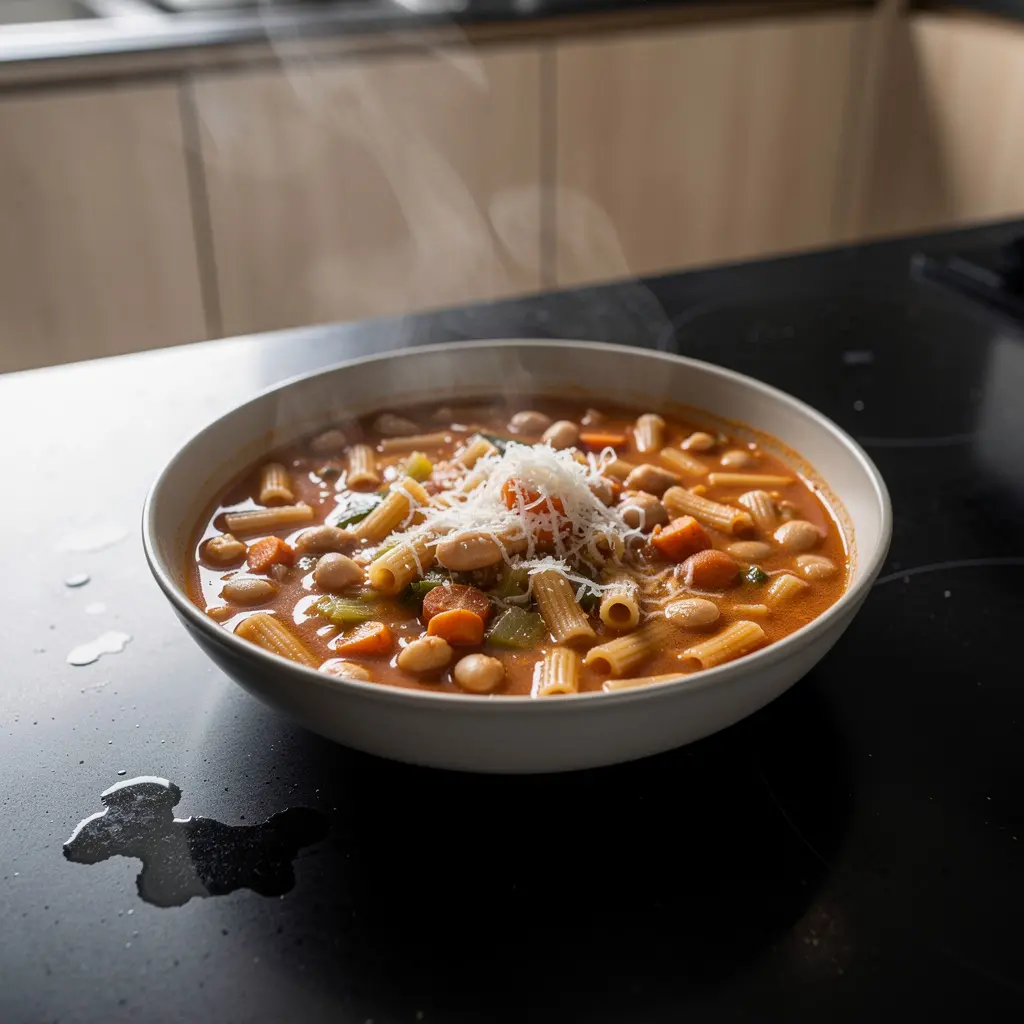
Pasta e fagioli is a thick, homestyle Italian bean and pasta soup-stew, popular from Emilia-Romagna down to Campania. Part of the beans break down into the tomato‑herb broth, creating a creamy base studded with springy pasta and whole beans. The pasta is cooked directly in the broth, so every piece is seasoned from the inside out.
This is one of the most “homey” dishes in Italian cooking, with small variations in every region – in the north it’s more like a soup, in the south it resembles a stew. It’s often made using leftover stock and vegetables as a clever zero‑waste way to cook.
Pasta e fagioli is the essence of Italian “cucina povera” – a few inexpensive ingredients turn into a bowl that is more filling than many meat dishes. It’s something between a thick soup and a pasta dish: the creaminess of the cooked-down beans combines with al dente pasta and an aromatic soffritto vegetable base. It tastes homely and warming, but thanks to the herbs and tomatoes it has a completely different character from Polish one-pot classics.
Why this version works
- Mashing part of the beans thickens the soup naturally, without flour or cream, and deepens the beany flavour.
- The pasta cooks in the same pot as the beans and passata, so every bite is rich and concentrated rather than watery.
- Adding the liquid gradually makes it easy to hit that sweet spot of thick but still spoonable consistency.
- Letting the soup rest briefly after cooking evens out the flavour and thickens it slightly, without any extra thickeners.
Chef's tips
I always mash some of the cooked beans with a fork or blend them smooth before adding to the pot – this naturally thickens the dish without flour. I cook the pasta directly in the broth with the beans, making sure to stir from time to time, as it tends to stick to the bottom when the sauce is thick. Be careful with the amount of salt at the beginning, especially if you’re using stock or canned beans; it’s better to add more at the end once the flavours have come together.
How to serve
Pasta e fagioli is perfect for colder days when you come home from work chilled and need something that really warms you from the inside – serve it in deep bowls with a drizzle of olive oil and some fresh rosemary on top. All you need alongside is a slice of toasted bread rubbed with garlic and a glass of simple, rustic red wine, such as Sangiovese. It’s also a great way to “clear out the pantry” on Sunday evening when you have leftover odds and ends of pasta and an open can of beans.
Watch out for
- Don’t over‑salt at the start – salty stock and Parmesan will easily boost the saltiness at the end.
- Pasta in a thick soup tends to catch on the bottom; stir more often, especially in the last few minutes.
- If the heat is too high, the liquid will evaporate too quickly and the pasta will cook unevenly and may split.
Substitutions
- You can swap the white beans for borlotti or a mixed medley of pulses, keeping the same total weight.
- You can replace the passata with finely chopped canned tomatoes, lightly crushing them.
- You can substitute rosemary with thyme or sage, using slightly less as they are quite intense.
Ingredients
- cooked white beans can be canned, drained; about 2 cans - 400 g
- short pasta (ditalini, fusilli or small tubes) - 200 g
- carrot diced finely - 1 piece
- stalk of celery diced finely; can be omitted - 1 piece
- onion finely chopped - 1 piece
- garlic cloves chopped - 2 piece
- tomato passata - 300 g
- vegetable or chicken stock can be made from a cube, but homemade will be tastier - 800 ml
- olive oil - 3 tablespoons
- fresh rosemary or thyme or 0.5 teaspoon dried - 1 sprig
- bay leaf - 1 piece
- grated Parmesan for serving; can be replaced with another hard cheese - 30 g
- salt and pepper to taste
Preparation
- Dice the carrot, celery and onion into a fine, even dice, and finely chop the garlic. Thanks to the similar size, the vegetables will soften at the same time.
- In a large, heavy pot heat the olive oil over medium heat. Add the carrot, celery and onion, season with a pinch of salt and sauté for 6–8 minutes, until soft and glossy‑translucent, with no browned edges.
- Add the garlic and fry for about 1 minute, until very fragrant. If it starts to darken quickly or sizzle very loudly, immediately lower the heat so it doesn’t turn bitter.
- Pour in the passata and add the bay leaf and the sprig of rosemary or thyme. Cook for 3–4 minutes over low heat, until the sauce thickens slightly and starts to gently “spit” around the edges of the pot.
- Add the stock and half of the beans. Bring to a boil, then reduce the heat and cook for 10 minutes, until the vegetables are completely soft and the surface of the soup is just gently simmering.
- Mash the remaining beans with a fork or briefly blend to a thick paste and add to the pot. After stirring, the liquid should noticeably thicken and turn creamy, but still remain slightly fluid.
- Add the pasta directly to the soup. Cook according to the time on the package (usually 8–10 minutes), stirring every 1–2 minutes and scraping the bottom so the pasta doesn’t stick; the soup should only be at a gentle simmer.
- If the soup becomes too thick and the pasta is barely covered, add hot stock or water half a cup at a time. The consistency should be like a very thick soup that slowly slides off the spoon.
- When the pasta is al dente, season with salt and freshly ground black pepper. Remove the bay leaf and herb sprig so they don’t turn bitter, and set the pot aside for 5 minutes so the soup thickens slightly.
- Serve very hot, sprinkled with Parmesan and drizzled with a little good olive oil. The soup should be thick yet still pour loosely from the spoon, with visible whole beans.
Storage
Store in the fridge for up to 3 days. The soup will thicken as it stands – when reheating, add a little water or stock and heat gently, stirring occasionally.
I usually cook pasta e fagioli on Mondays, when after the weekend I’m left with some homemade stock and vegetables that need to be used up. I like to make a big pot at once and set aside a portion in a thermos – the next day it’s my emergency lunch for work.