Onigirazu – Japanese Rice Sandwich with Tuna Recipe
Onigirazu is something between a sandwich and a large onigiri – a flat “parcel” of rice and filling wrapped in nori. In Japan it often goes into bento boxes as a convenient lunch for work or school, because it’s easy to hold in your hand and eat without cutlery. The tuna and mayonnaise version is mild, filling, and very friendly for beginners exploring Japanese flavors.
Onigirazu was created in the 1990s as a simpler, quicker version of classic onigiri, easy to fill with more generous amounts of stuffing. Today it’s a staple of Japanese bento boxes, as it travels well and is convenient to eat with your hands.
Onigirazu combines the convenience of a sandwich with the flavors of Japanese rice dishes. It’s easy to pack, eat with your hands, and customize with different fillings, making it perfect for bento boxes and portable lunches.
Why this version works
- Thoroughly draining the rice before cooking gives you springy, non-soggy grains that are perfect for shaping.
- A thick, well‑drained tuna filling doesn’t leak out and won’t make the nori soggy from the inside.
- Letting the wrapped parcels rest in plastic wrap allows the nori to soften evenly and adhere tightly to the rice.
- The instructions for shaping the rice into a square help you get an even cross‑section and a handy, consistent shape.
Chef's tips
Use short-grain Japanese rice or sushi rice so the grains stick together properly and the parcel holds its shape. Don’t overfill the center, otherwise the nori may tear or the onigirazu will be hard to wrap tightly. A slightly damp, very sharp knife will give the cleanest cut and the prettiest cross-section.
How to serve
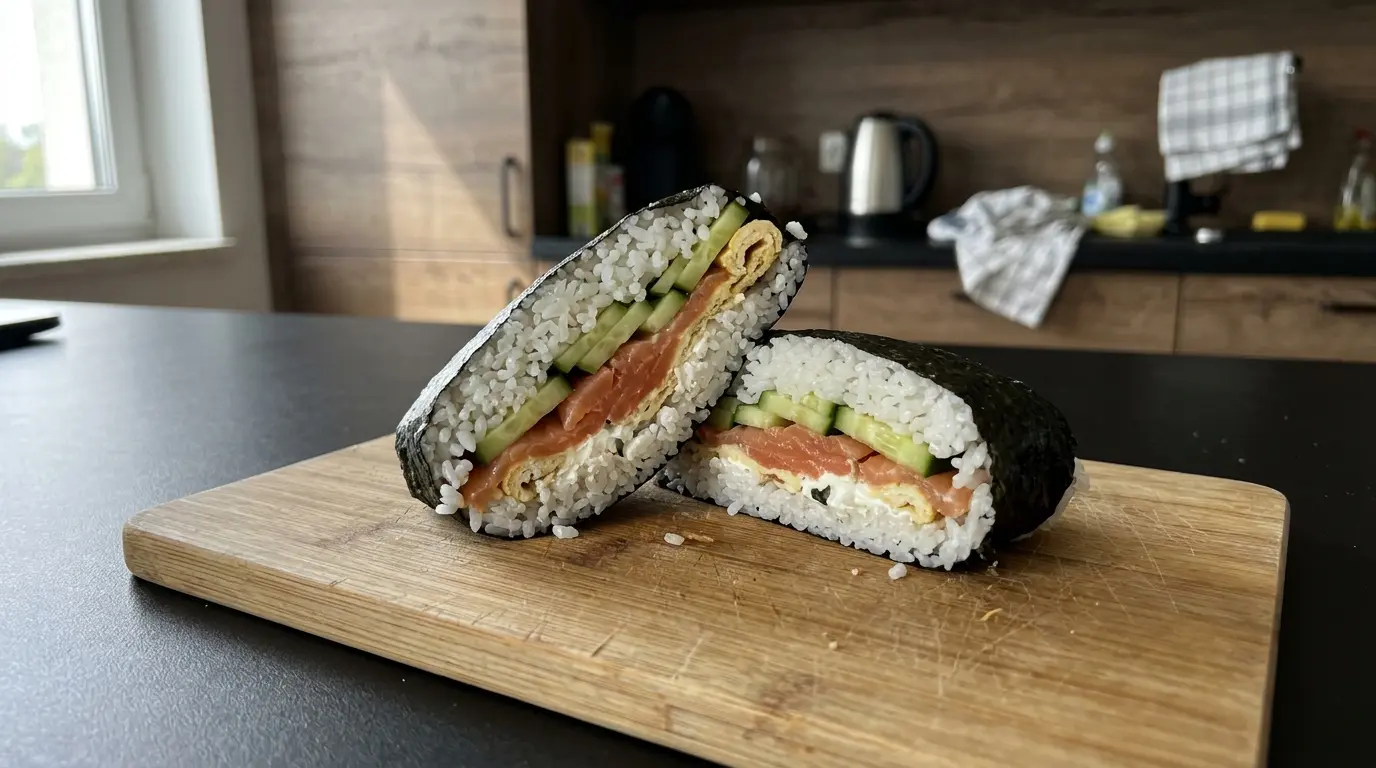
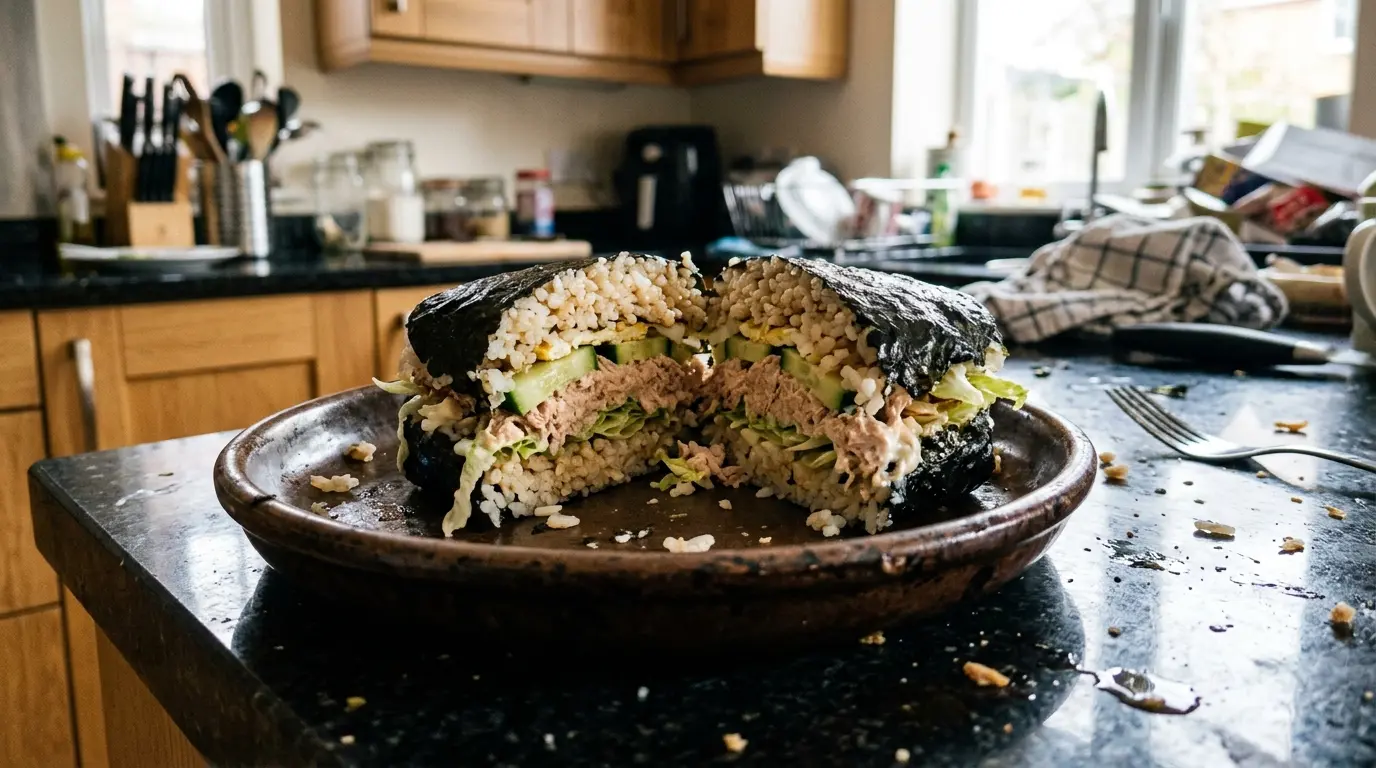
Serve onigirazu cut in half so the layers are clearly visible. Add a small dish of extra soy sauce or a mild chili mayo for dipping. It works well alongside a simple miso soup, pickled vegetables, or a fresh salad.
Watch out for
- Rice that’s too hot will over‑soften the nori, which will start tearing as you fold.
- Overstuffing the center will cause the nori to crack and the filling to squeeze out when slicing.
- Wet cucumber or lettuce will quickly soak the nori and make it harder to eat the onigirazu neatly with your hands.
Substitutions
- You can replace the tuna with smoked salmon mixed with a little mayonnaise and lemon juice.
- Instead of lettuce, use finely shredded carrot or sprouts, making sure to dry them very well.
- If you don’t have rice vinegar, use apple cider vinegar, reducing the amount by 1/3 and adding a pinch more sugar.
Ingredients
- rice - 250 g
- water - 300 ml
- rice vinegar - 40 ml
- sugar - 10 g
- salt - 2 g
- nori sheets - 4 piece
- tuna in brine or oil, drained - 160 g
- mayonnaise - 3 tablespoons
- cucumber - 0.5 piece
- lettuce leaves - 4 leaves
- soy sauce - 1 tablespoon
- black pepper ground - 1 pinch
Preparation
- Rinse the rice in cold water 5–6 times, until the water is almost clear. Leave the rice in a sieve for 10–15 minutes, until the grains look matte and stop dripping – the surface shouldn’t be wet.
- Transfer the rice to a pot with a thick bottom, pour in 300 ml of water and cover. Bring to a boil over medium heat until you see large bubbles, then reduce the heat to low and cook for 10 minutes without lifting the lid – the surface should “pulse” gently rather than boil vigorously.
- Turn off the heat and leave the rice covered for another 10 minutes to finish steaming. The cooked rice should be soft, springy and slightly sticky, with no broken grains or puddles of water at the bottom.
- In a small saucepan, gently heat the rice vinegar with the sugar and salt, stirring until the crystals are fully dissolved. Transfer the warm rice to a wide bowl, pour over the seasoning and gently fold with a spatula until the grains are evenly moistened and slightly glossy; set aside to cool to warm hand temperature.
- Very thoroughly drain the tuna, and if needed, gently squeeze it in a paper towel. In a bowl, combine the tuna with the mayonnaise, soy sauce and pepper, mashing into a paste – it should be thick, creamy and hold to the spoon, with no visible liquid.
- Cut the cucumber into thin lengthwise strips. Wash the lettuce leaves and pat them dry with paper towels until dry to the touch; if needed, cut them in half so they fit inside – the edges shouldn’t stick out beyond the rice.
- On a board, place a sheet of nori matte side up in a diamond shape, with one corner pointing towards you. In the center, spread a thin layer of warm rice into an 8–9 cm square, lightly pressing it down with damp hands; the surface should be even, but not packed as tightly as a brick.
- Place a lettuce leaf on the rice, add 1/4 of the tuna mixture and a few cucumber strips, forming a flat, even layer without a mound. Cover with a thin layer of rice of the same size, so the filling is fully enclosed and the sides of the nori have at least 2–3 cm of space for folding.
- Fold the bottom corner of the nori over the center and press so it adheres to the rice. Then fold the right, top and left corners, forming a tight parcel; if the edges are stiff and don’t stick, moisten your finger with water and run it along the inner side of the nori until it becomes slightly flexible.
- Tightly wrap the finished parcel in plastic wrap, gently flattening it with your hand to even out the filling. Set aside for 5–10 minutes, until the nori softens and clings to the rice; just before serving, cut each parcel diagonally in half with a sharp, damp knife in one decisive motion.
Storage
No storage information available for this dish.
This tuna onigirazu is a great introduction to Japanese home-style cooking: it doesn’t require special tools, and most ingredients are easy to find. Once you get comfortable with the folding technique, you can experiment with endless fillings, from classic tuna-mayo to vegetarian or more adventurous combinations.