Cornetti Italiani – Italian Breakfast Croissants Recipe
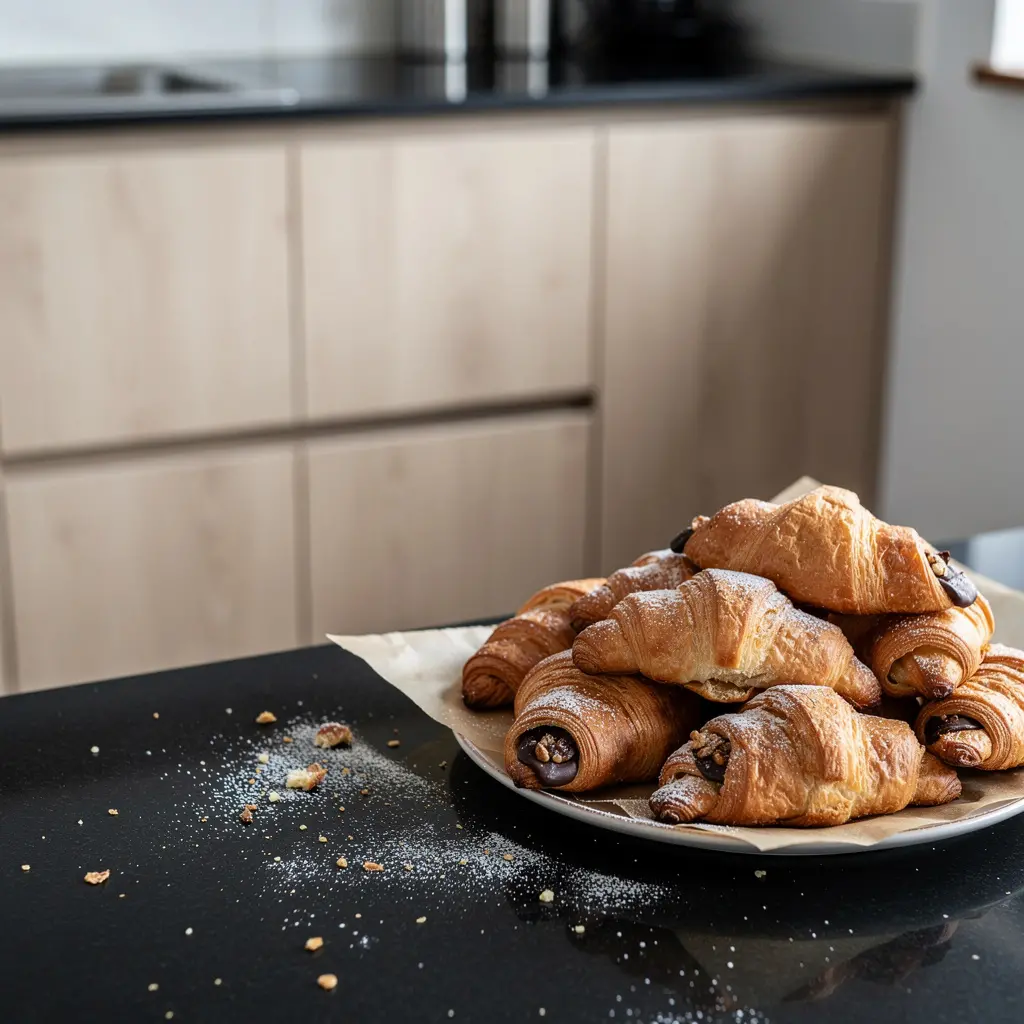
Cornetti are the Italian cousins of French croissants – a bit less buttery, but often delicately sweet and citrusy. Italians eat them in the morning at the bar with a cappuccino, but you can also bake them at home for a lazy weekend breakfast. The dough is yeasted, soft and fluffy, and the croissants can be filled with jam, chocolate spread or left plain and simply dusted with icing sugar.
In Italy, a cornetto with coffee, drunk standing at the bar, is an everyday ritual, and the pastries are often filled with jam, chocolate–hazelnut spread or pastry cream. Unlike French croissants, they are less buttery, more yeasted and are often scented with citrus.
Cornetti are the essence of an Italian bar breakfast – yeasted croissants, delicately sweet and often scented with citrus zest, perfect for dipping into cappuccino. They’re less buttery and lighter than French croissants, but fluffier and softer inside, so they taste great on their own or with filling. This bake turns an ordinary morning at home into a little trip to a Roman café.
Why this version works
- Skipping lamination simplifies the recipe while keeping a light, yeasted structure.
- Longer kneading and two proofings create an evenly aerated, soft crumb.
- Citrus zest builds the characteristic aroma of an Italian bakery without artificial flavorings.
- Adding the filling before rolling gives generously filled cornetti that don’t burst open.
Chef's tips
Knead the yeast dough until it’s really smooth and elastic – that’s the key to nicely risen, soft croissants; when kneading by hand this usually takes about 10 minutes. Make sure the milk is only lukewarm, not hot, because too high a temperature will kill the yeast and the dough won’t rise. When shaping the cornetti, don’t roll the dough too thin – very thin “arms” of the croissant dry out easily and over-brown in the oven.
How to serve
They’re best freshly baked, still slightly warm, served with cappuccino or latte and a small glass of water – just like in an Italian bar. You can fill them with homemade apricot jam, chocolate-hazelnut spread or lemon curd and serve for a lazy Saturday breakfast. If any are left for the next day, gently reheat them in the oven or in a dry pan and serve with butter and honey as a quick afternoon treat.
Watch out for
- Don’t dust the work surface with too much flour – the excess will be absorbed into the dough and dry out the cornetti.
- Arms of the triangles rolled too thin dry out easily and turn hard.
- Don’t shorten the second proof – dense rolls will rise poorly in the oven.
Substitutions
- Replace fresh yeast with 7 g instant dry yeast, adding it directly to the flour.
- Swap lemon zest for orange zest for a milder, sweeter aroma.
- You can add 2–3 tablespoons of cream to part of the milk if you want a richer flavor.
Ingredients
- flour - 500 g
- lukewarm milk not hot, just slightly warm - 250 ml
- fresh yeast or 7 g instant yeast - 20 g
- sugar - 80 g
- soft butter at room temperature - 80 g
- egg for the dough - 1 piece
- egg yolk for brushing - 1 piece
- grated zest of a lemon or orange only the coloured part - 1 piece
- pinch of salt - 1 pinch
- sugar optional
- jam, chocolate spread or nut spread optional, for filling - 100 g
Preparation
- If using fresh yeast, prepare a starter: pour the lukewarm milk into a small bowl (it should feel pleasantly warm, not hot), add crumbled yeast, 1 tablespoon of sugar and 2 tablespoons of flour. Mix and set aside for 10–15 minutes until the mixture clearly swells and develops a thick foam on top with no visible yeast lumps. If using instant yeast, you can skip this step and add it directly to the flour.
- In a large bowl combine the flour, remaining sugar, salt and finely grated citrus zest. Mix with your hand or a whisk until the zest is evenly dispersed in the flour and there are no clumps; the mixture should smell distinctly citrusy.
- Add the egg, soft butter and the yeast starter (or milk with instant yeast). Start kneading the dough by hand or with a dough hook until everything comes together into a uniform, slightly sticky ball with no dry patches of flour at the bottom of the bowl.
- Continue kneading for 8–10 minutes by hand or with the dough hook. The dough is ready when it is smooth, elastic, pulls away from the sides of the bowl and, when gently stretched between your fingers, forms a thin, springy “windowpane” that doesn’t tear immediately.
- Shape the dough into a ball, place it in a lightly oiled bowl and cover. Leave in a warm place for 1–1.5 hours, until it has at least doubled in volume; when you gently press it with a finger, the dent should remain visible and slowly spring back.
- Turn the dough out onto a lightly floured surface and gently flatten it with your hand to knock out the largest air bubbles. Roll it out into a circle about 0.5 cm thick; the surface should be smooth, without holes or torn edges.
- Cut the circle into 12 wedges like a pizza. Place a teaspoon of filling on the wide end of each wedge, leaving about a 0.5 cm margin so the filling doesn’t leak out while rolling and baking.
- Roll up each wedge from the wide base to the tip, gently stretching the dough so you get tight spirals. Place the rolls on a baking tray lined with baking paper, with the tip tucked underneath, leaving plenty of space between them as they will rise again.
- Cover the cornetti with a cloth and leave to rise for 30–40 minutes, until they puff up visibly and feel light, like little cushions; when you gently touch one with a fingertip, the indentation should fill in very slowly. Meanwhile, preheat the oven to 180°C, top and bottom heat.
- Mix the egg yolk with 1 tablespoon of milk and very gently brush a thin layer over the tops of the rolls. Bake for 15–20 minutes, until evenly golden, with lightly browned edges and a strong buttery, citrusy aroma.
- Transfer the baked cornetti straight onto a wire rack so the bottoms don’t get soggy and stay slightly springy. When they have cooled slightly, dust with icing sugar and serve while still warm – the inside should be soft and silky to the touch.
Storage
Store cooled cornetti in an airtight container at room temperature for up to 2 days, or freeze them once baked and cooled. Reheat briefly in the oven or toaster oven before serving to refresh their texture.
I usually bake cornetti on Friday evening so that on Saturday morning I only need to reheat them and we can pretend we’ve gone out for breakfast, even though we’re still in our pyjamas at the kitchen table. I also sometimes freeze some of the shaped, unbaked croissants so I can quickly bake a fresh batch on a weekday before catching an early train.