Yeast cake with cheese and crumble Recipe
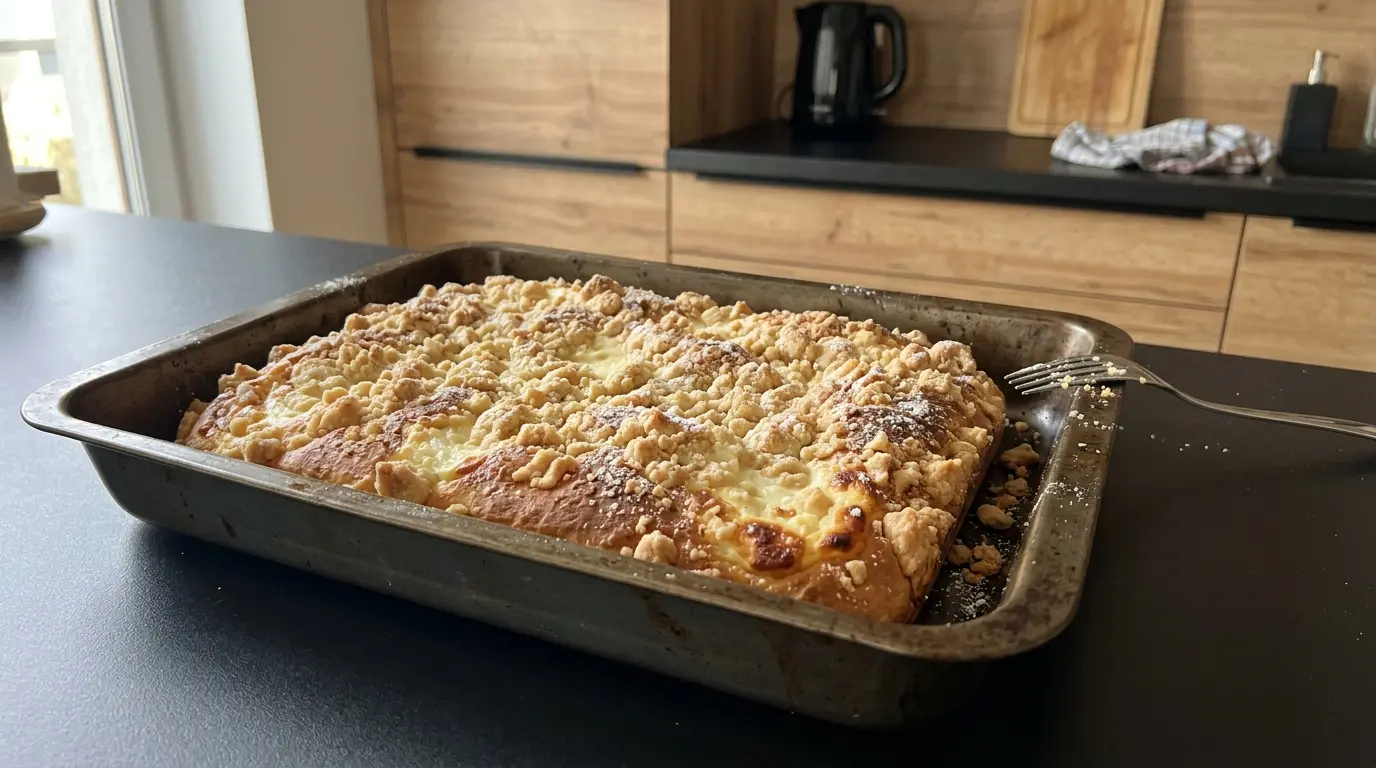
This yeast cake with a thick layer of sweet curd cheese and buttery crumble is like a cross between a big bakery-style sweet bun and a sheet-pan cheesecake. The base is soft and springy, the cheese layer creamy, and the crumble distinctly crunchy. The proportions of dough to cheese are chosen so the dessert stays fresh for a long time and the cheese mixture doesn’t soak into the base.
This kind of yeast cake with cheese and crumble often appears on Polish Sunday tables as a “cake for coffee”, combining in one bake the sweet bun and cheesecake flavours of traditional family bakeries.
This cake combines three favourite elements of Polish baking: a yeast base, a cheese layer and a thick, buttery crumble., It replaces several desserts at once, so it’s perfect when you don’t want to bake cheesecake and sweet buns separately., The structure stays fresh for a long time and also freezes well in portions.
Why this version works
- The ratio of curd cheese to dough gives a thick yet stable cheese layer that doesn’t collapse after baking.
- Chilled crumble holds its shape better and bakes up distinctly crunchy.
- The double rise makes the dough light but not dry.
- Kneading with the butter added at the end gives a springy yet soft crumb.
Chef's tips
If after 15 minutes the starter is flat and without foam, the yeast is weak – it’s better to make a new one than risk a dense cake., When stretching the dough in the tin, don’t tug it; gently push it out with your fingers until the surface is even and without holes., Sprinkle the crumble from a height so it spreads more evenly and doesn’t form heavy, greasy patches of butter.
How to serve
It tastes best on the day of baking, slightly warm, with coffee and milk or tea with lemon., For a more dessert-like version, serve it with a dollop of sour cream or thick yogurt to balance the sweetness of the cheese and crumble.
Watch out for
- Milk that is too hot will kill the yeast – if it burns your finger, let it cool a bit first.
- Don’t skip or shorten the second rise on the tray, otherwise the cake may crack and turn out dense.
- Don’t cut the cake while hot – the cheese layer will run and tear the base.
Substitutions
- You can replace the curd cheese with thick tub-style cheesecake curd, adding 1–2 tablespoons of semolina if needed.
- Swap vanillin sugar for 1 teaspoon of vanilla paste or sugar with real vanilla.
- You can replace about 50 ml of the milk with 30% cream for a richer, more buttery flavour.
Ingredients
- wheat flour - 500 g
- milk - 250 ml
- yeast - 25 g
- sugar - 80 g
- egg - 2 piece
- butter - 80 g
- salt - 0.5 teaspoons
- curd cheese - 400 g
- powdered sugar - 60 g
- egg yolk - 1 piece
- vanillin sugar - 8 g
- wheat flour - 80 g
- sugar - 50 g
- butter - 50 g
Preparation
- Gently warm the milk – when you dip in a finger it should feel warm but not hot. Crumble the yeast into a small bowl, add 1 tablespoon of sugar, 2 tablespoons of flour and some of the milk. Mix to a smooth paste and leave for 10–15 minutes until it foams up clearly.
- Put the remaining flour, sugar and salt into a large bowl. Add the risen starter, eggs and the rest of the milk. Knead by hand or with a dough hook for about 5 minutes, until no dry patches of flour remain and the dough starts to become slightly stretchy.
- Pour in the melted, cooled butter and knead for another 5–7 minutes, until the dough is smooth, elastic and starts to come away from the sides of the bowl and your hands. The surface should be slightly shiny and springy to the touch.
- Cover the bowl with the dough with a cloth and leave in a warm, draft-free place for about 1 hour, until doubled in volume. When you press a finger into it, the indentation should slowly fill back in rather than sinking deeply.
- Meanwhile, prepare the cheese mixture: mash the curd cheese with a fork or blend briefly to remove lumps. Add the powdered sugar, egg yolk and vanillin sugar, and mix to a smooth, thick mixture that doesn’t run off the spoon.
- Make the crumble: put 80 g flour and 50 g sugar into a bowl, add 50 g cold butter in cubes. Rub together with your fingers until you get clumps of various sizes resembling wet sand. Place the bowl in the fridge.
- Line a baking tin of about 25×35 cm with baking paper. Briefly knead the risen dough to knock out the air, transfer it to the tin and gently stretch it out with your fingers into an even layer with a slight rim around the edges.
- Cover the dough with a cloth and leave for about 20 minutes, until it puffs up again slightly and feels soft to the touch. When you gently shake the tin, the surface should wobble slightly, not feel stiff.
- Spread the cheese mixture over the risen dough in an even layer, leaving a small margin around the edges so the cheese doesn’t leak out. Sprinkle the well-chilled crumble all over, trying not to leave large gaps.
- Preheat the oven to 180°C, top and bottom heat. Put the cake in and bake for 30–35 minutes, until the crumble turns golden and the edges of the dough pull slightly away from the tin. When you press the centre lightly, it should spring back.
- Remove the baked cake from the oven and leave it in the tin to cool completely. As it cools, the cheese layer will firm up noticeably – if you cut it too early, it will ooze and tear the base.
Storage
After 1–2 days the cake dries out slightly and the crumble softens, but after a short reheat at 150°C it becomes soft and aromatic again., Individual pieces can be frozen; after thawing, refresh them in the oven for a few minutes.
I most often bake this tray when my parents come over – my mum always starts with “just a thin slice” and ends up going back for seconds; I reserve the middle of the tray for myself because that’s where there’s the most cheese.