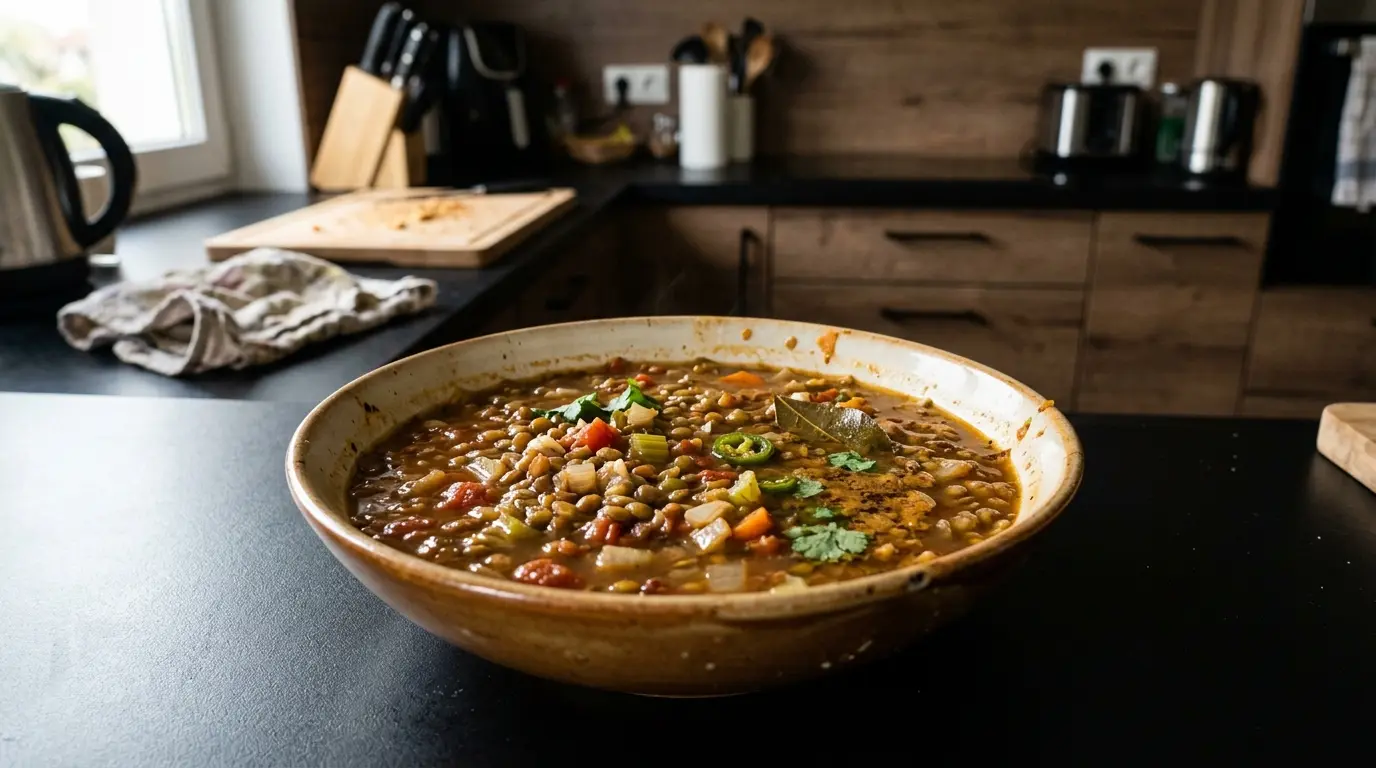
Sambar – vegetable lentil stew with tamarind Recipe
This streamlined South Indian-style sambar pairs soft red lentils with potatoes, carrots, green beans, tomatoes, and tamarind. Red lentils give it a velvety body, while mustard seeds, curry leaves, toasted ground spices, and a final sour note keep it from reading as an ordinary vegetable dal. The vegetables are cut to cook at the same pace, and the tamarind goes in only after they are tender.
Sambar is a South Indian lentil and vegetable preparation commonly served with idli, dosa, rice, and other everyday dishes. Regional and household versions vary widely. This is an accessible adaptation using quick-cooking red lentils and individual ground spices, while retaining the important sequence of cooked lentils, a mustard-and-curry-leaf tempering, and tamarind added after the vegetables soften.
The character of this version comes from contrast: creamy red lentils, vegetables that remain identifiable, a sharp tamarind finish, and mustard seeds and curry leaves fried directly in oil. Although the spice list is concise, blooming each element at the right moment produces a clearer sambar profile than simply boiling all the seasonings with the lentils.
Why this version works
- Potatoes cut into 1.5 cm cubes, thinly sliced carrots, and shorter bean pieces reach tenderness within a predictable cooking window.
- Adding the beans after the first 8 minutes prevents them from becoming dull and overly soft before the potatoes are cooked.
- The mustard seeds and curry leaves season the hot oil first, carrying their aroma throughout the finished stew.
- Ground spices are heated briefly and protected by the tomatoes, so they become fragrant without scorching.
- Diluting the tamarind paste in exactly 100 ml of the measured water distributes it evenly and keeps the final consistency pourable.
- Tamarind is withheld until the potatoes and carrots are tender because acidity can slow the softening of vegetables.

Chef's tips
If the lentils look unevenly broken down, press a ladleful against the side of the pot and stir it back in rather than blending the stew. Judge the texture only after adding the 100 ml tamarind mixture, since it noticeably loosens the lentils. Fresh coriander is best added at the end so its aroma remains distinct from the cooked curry leaves.
How to serve
Serve the sambar hot with idli or dosa, or ladle it over rice. Its thick but flowing consistency should be loose enough to soak into the accompaniment while still carrying pieces of potato, carrot, and green bean in each serving.
Watch out for
- Use a pot with enough headroom: red lentils foam as they first come to a boil.
- Keep the simmer moderate and scrape the bottom periodically, especially once the lentils begin to collapse and thicken.
- Make sure the curry leaves are dry before adding them to the oil; damp leaves can cause forceful splattering.
- Do not wait for the mustard seeds to turn dark. Once they crackle and jump, add the curry leaves promptly.
- Check the center of a potato cube before adding tamarind. A tender surface can conceal a firm middle.
- Avoid blending the entire pot; the broken-down red lentils already provide body, while the vegetable pieces give the sambar texture.
Substitutions
- If tamarind paste is unavailable, use the previously suggested alternative of 1–2 tablespoons lemon juice. Add it after taking the pot off the heat; the result will taste brighter and less rounded than tamarind.
Ingredients
- red lentils - 200 g
- carrot - 2 pieces
- potatoes - 2 pieces
- onion - 1 piece
- tomatoes - 2 pieces
- green string beans - 100 g
- vegetable oil - 2 tablespoons
- mustard seeds - 0.5 teaspoons
- curry leaves - 6 pieces
- ground cumin - 1 teaspoon
- ground coriander - 1.5 teaspoons
- turmeric - 0.5 teaspoons
- ground chili - 0.5 teaspoons
- tamarind paste - 1 tablespoon
- salt
- water - 900 ml
- fresh coriander - 2 tablespoons
Preparation
- Measure the 900 ml water and set aside 100 ml for the tamarind. Rinse the red lentils until the water is only lightly cloudy. Cut the potatoes into 1.5 cm cubes, slice the carrots into 5 mm half-moons, cut the green beans into 2.5 cm lengths, finely dice the onion, and chop the tomatoes into roughly 1 cm pieces.
- Put the lentils, potatoes, carrots, turmeric, 1/2 teaspoon salt, and the remaining 800 ml water in a medium pot. Bring to a boil, skim off any foam, then lower the heat to maintain a steady simmer. Cook partially covered for 8 minutes, stirring once or twice across the bottom of the pot.
- Add the green beans and continue simmering for 8–12 minutes. The lentils should lose their shape, the carrots should be tender, and a potato cube should yield easily when pierced through the center. If the potato is still firm, keep cooking before adding any acidic ingredients.
- While the vegetables cook, heat the vegetable oil in a small frying pan over medium heat. Add the mustard seeds and cook for 20–40 seconds, until they crackle and begin jumping. Add the curry leaves carefully, as they may spit in the hot oil, and stir for about 10 seconds.
- Add the diced onion to the tempering and fry for 6–8 minutes, stirring regularly, until soft with pale golden edges. Stir in the ground cumin, ground coriander, and ground chili for 15–20 seconds, just until fragrant; do not let the dry spices darken.
- Immediately add the tomatoes and cook for 6–8 minutes. Press them with the spoon as they soften. The mixture is ready when it looks pulpy and concentrated, with a slight sheen of oil appearing around the edges.
- Scrape the tomato-onion mixture into the cooked lentils and vegetables. Stir well and simmer uncovered for 5 minutes so the tempered spices disperse through the stew. It should be thicker than the finished sambar at this point because the tamarind water will loosen it.
- Stir the tamarind paste into the reserved 100 ml warm water until evenly dissolved, then pour it into the pot. Simmer for 3–4 minutes. Taste and adjust the salt. The finished sambar should coat a spoon lightly but run from the ladle rather than sit like a puree; simmer a few minutes longer if it is too loose.
- Take the pot off the heat and stir in or scatter over the fresh coriander. Let the sambar stand for 5 minutes before serving so the tart tamarind, tomato, and tempered spices settle into the lentils.
Storage
Sambar thickens in the fridge; when reheating, add a little water and bring to a gentle boil, stirring., After defrosting, bring it to a good boil so it regains a uniform consistency.
I prefer this sambar after a short rest rather than straight from a vigorous boil. Five minutes is enough for the mustard, curry leaf, tomato, and tamarind flavors to come together without sacrificing the fresh coriander aroma.