Pierogi with Sauerkraut and Mushrooms Recipe
Pierogi with sauerkraut and dried mushrooms are one of the most characteristic dishes of Polish Christmas Eve and winter lunches. Long-braised cabbage with mushrooms creates a dark, forest-scented filling with gentle acidity, enclosed in a thin, elastic dough scalded with hot water. In this version the filling is thoroughly reduced and finely chopped, so the pierogi seal well, don’t burst and have an even texture in every bite.
Pierogi with cabbage and mushrooms are a classic element of the Polish Christmas Eve supper, often served with red borscht. In many homes the filling is prepared several days in advance so the cabbage and mushrooms have time to meld before shaping the pierogi.
These pierogi have a filling that tastes like concentrated winter forest: dried mushrooms and cabbage are cooked for a long time until the aroma becomes deep and slightly smoky. The thin, tender dough doesn’t overpower the filling but holds it securely inside. Thanks to the well-reduced filling, they are also perfect for freezing and later pan-frying.
Why this version works
- Long braising and thorough reduction of the filling prevent leaking and the pierogi coming apart.
- Very finely chopping the cabbage and mushrooms gives a smooth filling without lumps poking through the dough.
- Dough scalded with hot water is elastic, rolls out thinly and doesn’t crack during cooking.
- Resting the dough before rolling relaxes the gluten and makes shaping the pierogi easier.
Chef's tips
Prepare the filling a day in advance – after a night in the fridge it becomes compact and easy to shape with a teaspoon instead of spreading out to the sides., If the dough starts to shrink and become stiff while you’re working, cover it with a bowl for 5 minutes, let it rest and then continue rolling., Be careful not to overfill the pierogi – if the edges pull apart or the filling squeezes out, use about half a teaspoon less.
How to serve
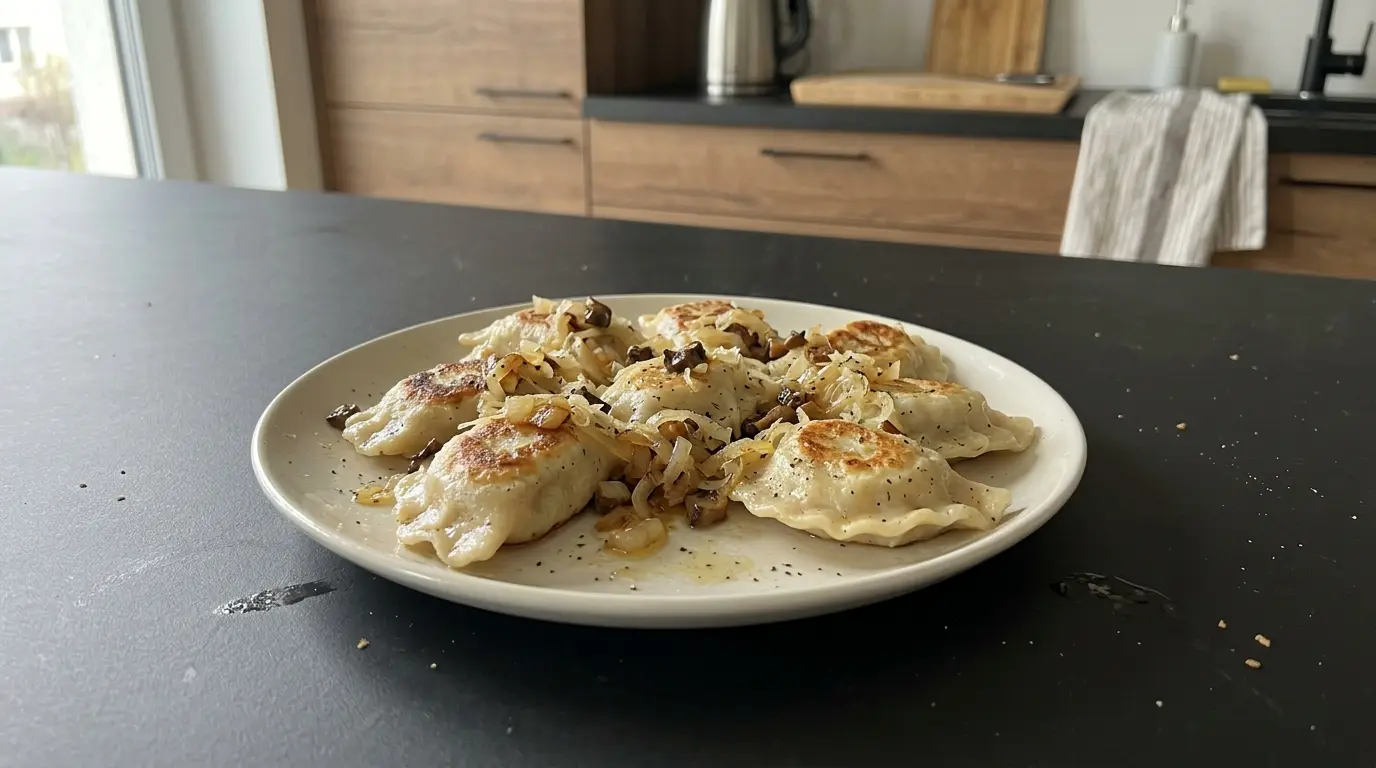
For Christmas Eve, serve the pierogi drizzled with clarified butter and topped with golden fried onion, or in a bowl with clear red borscht., After the holidays they are delicious pan-fried until crisp, served with a sauerkraut slaw or dill pickle and strong, unsweetened tea.
Watch out for
- Don’t use hot filling – the steam will soften the edges and the pierogi will come apart.
- An overly wet filling is the most common cause of pierogi bursting during cooking – fry until it is dry.
- Don’t add too much flour when rolling out, as the dough will become tough after cooking.
Substitutions
- You can replace part of the dried mushrooms with button mushrooms, but keep a handful of dried ones for aroma.
- Clarified butter in the filling can be replaced with rapeseed oil if the pierogi need to be completely meatless.
Ingredients
- flour wheat - 500 g
- hot water (not boiling) - 260 ml
- oil vegetable - 2 tablespoons
- salt for the dough - 0.5 teaspoons
- cabbage sauerkraut - 500 g
- dried mushrooms - 40 g
- onion - 2 pieces
- oil or clarified butter - 3 tablespoons
- bay leaf - 2 pieces
- allspice - 4 berries
- pepper ground black
- salt for the filling
Preparation
- Pour hot water over the dried mushrooms so they are completely covered and leave for at least 30 minutes, until they soften and sink to the bottom. For longer soaking, keep them in a cool place.
- Taste the sauerkraut; if it is very salty or sharp, briefly rinse in cold water and squeeze out thoroughly. Then chop it finely so there are no long strands poking through the dough in the filling.
- Transfer the sauerkraut to a pot, add the bay leaf and allspice, and pour in just enough water to barely cover. Cook for 40–50 minutes over low heat, until it softens, reduces in volume and is less watery.
- Drain the soaked mushrooms through a fine sieve, reserving the soaking liquid. If necessary, briefly rinse off any sand, then chop very finely – the pieces should be under 1 cm.
- Peel the onion and cut into a small dice. Heat 2 tablespoons of oil or clarified butter in a large frying pan, add the onion and fry for 5–7 minutes, until soft and pale golden, without dark, bitter edges.
- Add the chopped mushrooms to the onion and fry for 5–7 minutes, until most of the liquid has evaporated and you can smell an intense forest aroma. If the mixture starts to stick, add 2–3 tablespoons of the mushroom soaking liquid.
- Add the cooked, well-squeezed sauerkraut to the pan. Fry everything together for 10–15 minutes, stirring often, until the filling is clearly dry, slightly browned in places and with no visible puddles of liquid.
- Season the filling with salt and plenty of pepper, stir and leave to cool completely; the cold filling should be compact and not release liquid when scooped with a teaspoon.
- Put the flour and salt into a large bowl. Pour in the hot but not boiling water and the oil, mix with a spoon, and when the dough has cooled slightly, knead by hand for 5–7 minutes, until smooth and elastic. Cover and leave to rest for 15–20 minutes.
- Divide the dough into 3–4 portions. Roll each out on a lightly floured surface into a sheet about 2 mm thick – thin but not translucent. Cut out circles with a glass or cutter, trying not to leave wide scraps.
- Place a teaspoon of cold filling in the centre of each circle, leaving a clean edge. Fold in half and seal carefully from the middle towards the ends until you feel an even “rope” of dough under your fingers; if necessary, press the edges with a fork.
- Bring a large pot of well-salted water to a boil. Drop in the pierogi in batches, gently stirring only at the beginning so they don’t stick to the bottom. Cook for 2–3 minutes after they float to the surface – when done they will be slightly puffed and springy to the touch.
Storage
Store cooked pierogi in the fridge for up to 3 days, lightly drizzled with oil so they don’t stick together. After chilling, the dough tightens slightly – it’s best to reheat them by briefly boiling or pan-frying, and cook frozen ones without thawing.
I like making these pierogi at a big table when everyone has their own “station”: someone rolls, someone cuts, someone seals. I always set aside a few of the least pretty ones in a separate box – these are our “technical” pierogi to eat before Christmas Eve.