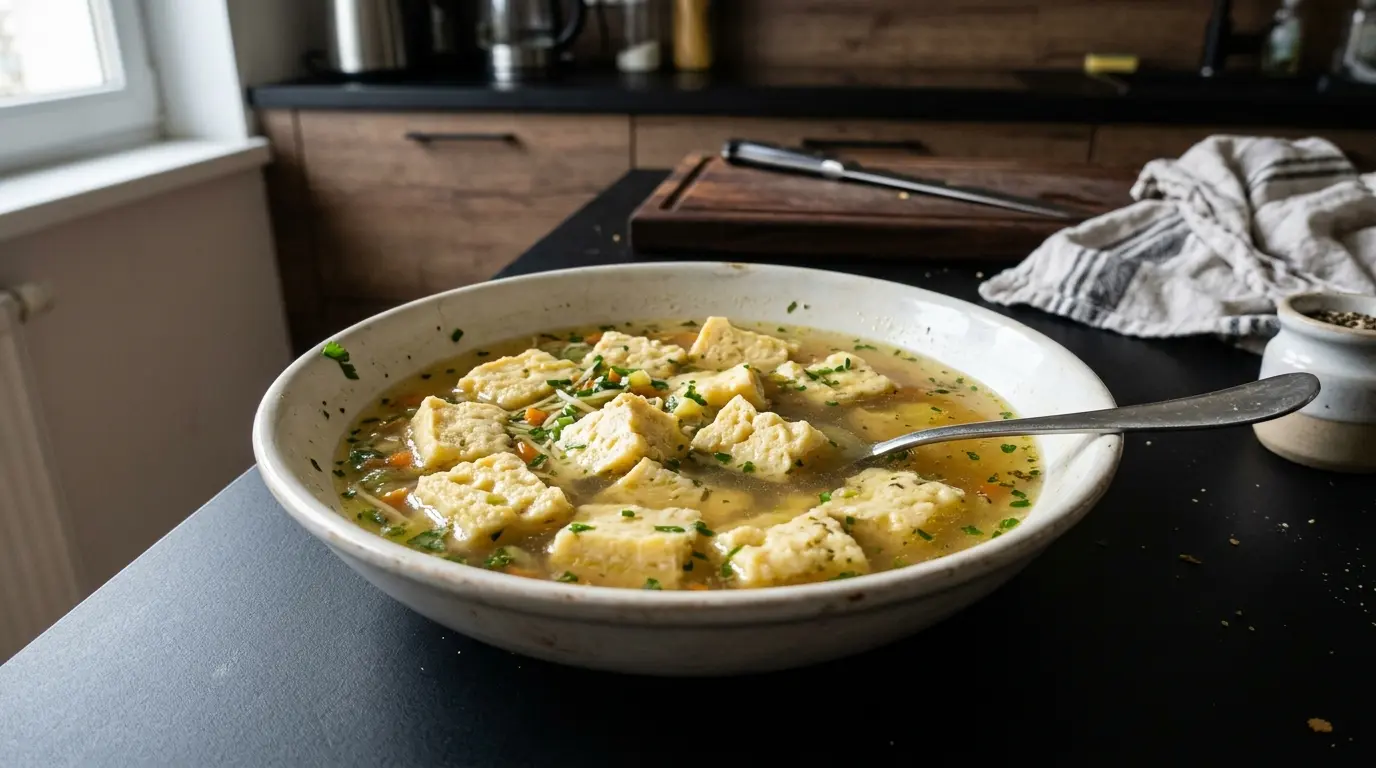
German Soup with Eierstich Egg Dumplings in Broth Recipe
Eierstich are delicate, egg-based “dumplings” steamed until set, then cut into cubes or diamonds and served in hot broth. In Germany they often appear in festive soups or as an elegant addition to clear chicken or beef broth. The taste is similar to a very delicate steamed omelette, but served as small pieces floating in the soup.
In Germany, Eierstich appears in clear broth for holidays, Sunday lunches, and in traditional inns, often alongside noodles or small dumplings. It’s a simple way to add elegance and heartiness to soup using inexpensive eggs and milk.
This classic German soup garnish turns a simple clear broth into an elegant, restaurant-style starter with very little effort. The silky, custard-like Eierstich adds both protein and a luxurious texture, while still keeping the dish light.
Why this version works
- Baking in a water bath at a low temperature gives a smooth, pore-free texture.
- Straining the mixture through a sieve removes egg membranes so the cubes look even and clean.
- Briefly heating it separately in the broth prevents the Eierstich from falling apart or becoming rubbery.
Chef's tips
Straining the egg mixture is the key to a perfectly smooth Eierstich, so don’t skip this step. If you see bubbles on the surface before baking, skim them off with a spoon for an even nicer texture. Keep the water in the bain-marie hot but not boiling vigorously, otherwise the mixture may become porous.
How to serve
Serve in pre-warmed soup plates or bowls so the delicate Eierstich stays hot longer. You can add a few extra fresh herb leaves on top for colour, or serve alongside a simple green salad for a light lunch.
Watch out for
- Vigorous boiling of the water bath will aerate the mixture and create sponge-like holes.
- Overbaking will dry out the Eierstich – take it out when the center is just slightly jiggly.
- If you beat the eggs too hard, too much foam will result in a porous texture.
Substitutions
- You can replace the milk with 18% cream for a richer, more velvety texture.
- You can swap nutmeg for a pinch of freshly grated ginger for a gently spicier note.
Ingredients
- chicken or beef broth clear - 1.5 l
- egg - 4 piece
- milk or 10–12% cream for a richer taste - 150 ml
- salt for the egg mixture, plus to taste for the broth - 0.5 teaspoons
- white pepper or black, finely ground - 0.25 teaspoons
- nutmeg grated, optional - 0.25 teaspoons
- butter for greasing the dish - 5 g
- chives chopped, for serving - 2 tablespoons
Preparation
- Preheat the oven to 150°C (top and bottom heat). Prepare a small ovenproof dish or tin (e.g. a loaf tin) that can be placed in a larger tray with water.
- Thoroughly grease the dish with a thin layer of butter so the egg mixture does not stick.
- In a bowl, whisk the eggs with the milk (or cream), add salt, pepper and nutmeg. Mix gently with a whisk, trying not to incorporate too much air so that not too much foam forms.
- Strain the egg mixture through a fine sieve into the prepared dish – this will make the Eierstich exceptionally smooth.
- Place the dish with the mixture into a larger tray or tin and pour in hot water so that it reaches roughly halfway up the sides of the dish with the eggs.
- Put everything into the oven and bake in a water bath for 20–25 minutes, until the mixture is set. When touched with a finger it should be springy like pudding, with no liquid centre.
- Remove the dish from the oven and leave it for a few minutes to cool slightly. Then gently loosen the set mixture with a knife around the edges, remove it from the dish and transfer to a board.
- Cut the Eierstich into cubes, strips or diamonds.
- Heat the broth in a pot and season with salt and pepper if needed. When hot, add the cut pieces of Eierstich and heat for 1–2 minutes without bringing to a vigorous boil.
- Ladle the soup into bowls, sprinkle with chopped chives and serve immediately.
Storage
Leftover Eierstich can be stored in the fridge for 1–2 days in a little broth and gently reheated in hot (not boiling) broth just before serving.
This soup is a nostalgic dish for many people in Germany, often associated with Sunday family lunches. It’s also a great way to use up extra eggs and broth while creating something that feels special and comforting.