Potato Pancakes with Sour Cream Recipe
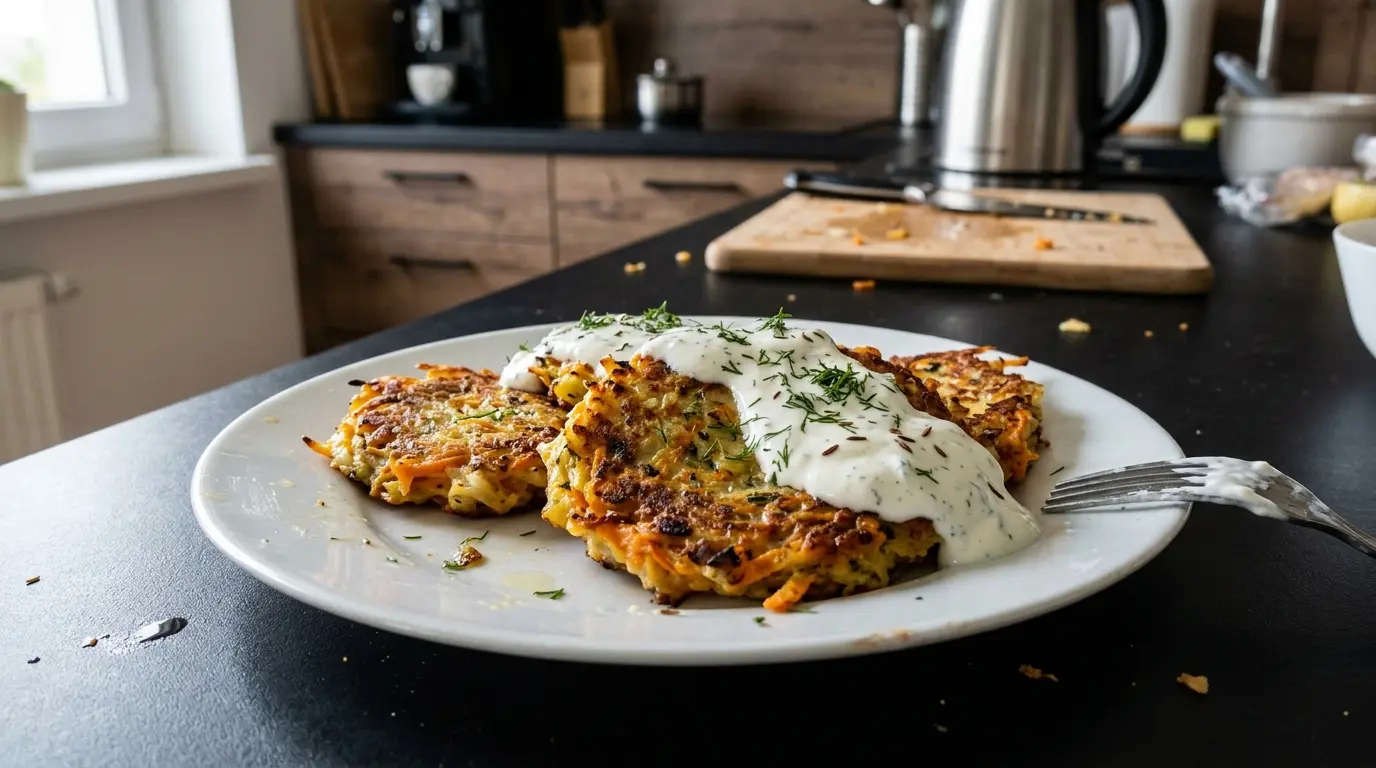
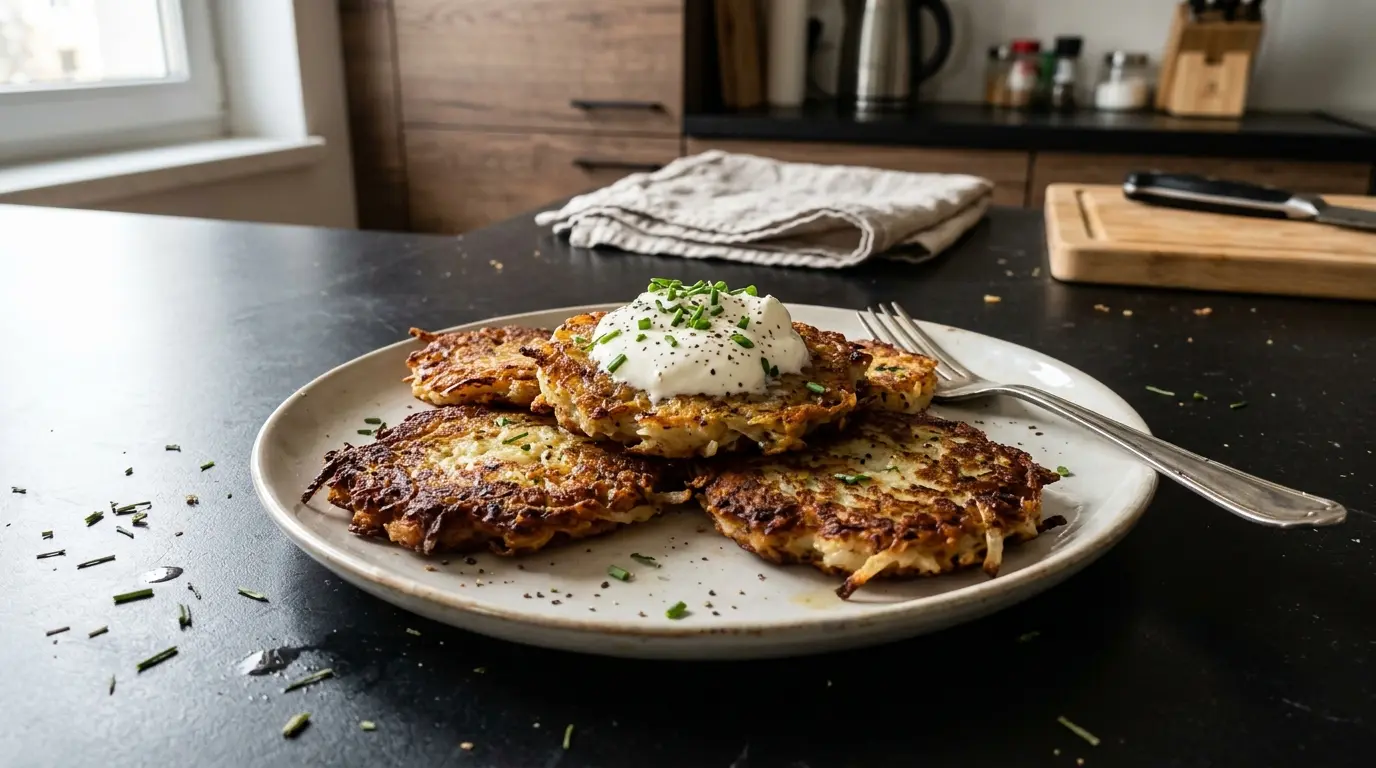
Potato pancakes with sour cream are one of the most recognizable, simple home‑style dishes in Poland. In this version they’re thin, deeply browned around the edges, with a soft center and a pronounced onion aroma. Thoroughly squeezing the potatoes and using their natural starch makes them very crispy without needing much flour.
Potato pancakes are found in many Central and Eastern European cuisines, but in Poland they’re most often served with sour cream or sugar. It’s a typical “something from nothing” dish, created from cheap potatoes available in winter and a few pantry staples.
This version focuses on a simple potato‑and‑onion flavor without herbs or extras, so every ingredient is clearly noticeable. The technique of thoroughly squeezing the potatoes and controlling the batter consistency makes the pancakes come out thin, deeply browned at the edges and soft inside. Sour cream added to the hot pancakes melts pleasantly and softens their richness.
Why this version works
- Squeezing out the potatoes and using the starch collected at the bottom of the bowl strengthens the structure of the pancakes without needing much flour.
- Keeping a steady thickness of about 0.5 cm makes even frying easier and gives lots of glassy‑crisp edges.
- Frying in well‑heated but not smoking oil limits how much fat the pancakes absorb.
Chef's tips
The most common mistake is batter that’s too thin – then the pancakes spread out in the pan and soak up a lot of fat, so always check how it runs off the spoon and, if needed, add a little flour., Treat the first batch as a test: if the pancakes are dense and not very crisp, add a spoonful of grated potato or a splash of water., While frying, watch the edges – when they’re deep golden and firm, the pancakes will flip without tearing.
How to serve
Serve the pancakes straight from the pan with a heaping spoonful of sour cream and a pinch of salt or pepper on top., They go great with a salad of sauerkraut or a dill pickle for a quick, late after‑work dinner., To drink, serve kefir, buttermilk or a glass of cold milk to nicely cut through the richness of the dish.
Watch out for
- Pancakes that are too thick may be raw in the middle despite a browned surface.
- If the batter starts to separate in the bowl, stir it before each portion you spoon into the pan.
- Do not cover the pan with a lid – the steam will immediately soften the tops and take away the crispness.
Substitutions
- You can replace part of the wheat flour with potato flour if you want an even crispier result.
- If you don’t like bits of onion, grate it into a paste or add only 1–2 tablespoons of finely grated onion.
- You can swap 18% sour cream for thick Greek yogurt seasoned with a pinch of salt.
- For frying, you can use clarified butter instead of vegetable oil for a more intense flavor.
Ingredients
- potatoes - 800 g
- onion - 1 piece
- egg - 1 piece
- flour wheat - 3 tablespoons
- salt
- pepper ground black
- oil vegetable for frying
- cream 18% sour - 200 g
Preparation
- Peel the potatoes, rinse and grate on the fine holes of a grater directly into a large bowl. Work as quickly as you can – the mixture may darken slightly, but it shouldn’t turn into a thin, watery juice.
- Peel the onion and grate it on the same grater, add to the potatoes and mix thoroughly. The mixture should be thick, with visible fine shreds of vegetables rather than a smooth purée.
- Set the bowl aside for about 5 minutes, until a layer of liquid collects on top. Carefully pour it off, leaving the white starch sediment at the bottom – it will look slightly chalky and fairly compact.
- Add the egg, flour, salt and pepper to the mixture. Stir until you get a uniform, thick batter that runs off the spoon in a thick, continuous ribbon; if it drips like water, add a little more flour, if it’s very stiff, add a spoonful of freshly grated potato.
- Heat a 2–3 mm layer of oil in a large heavy pan over medium‑high heat. When a small drop of batter immediately starts to sizzle and set around the edges, the fat is hot enough.
- Spoon the batter into the pan, forming pancakes about 0.5 cm thick. Gently flatten them with the back of the spoon, leaving gaps between the pancakes so the edges can brown freely and don’t fuse together.
- Fry the pancakes for 3–4 minutes on the first side, until the edges are deep golden, firm and release easily from the pan. If the edges are still pale and soft when you touch them with a spatula, wait a bit before flipping.
- Flip the pancakes in one confident motion using a wide spatula. Fry for another 2–3 minutes on the other side, until the whole surface is golden and distinctly crisp when you tap it with the spatula; reduce the heat if they brown too quickly.
- Transfer the finished pancakes to a plate lined with paper towel to drain off excess fat. Before each new batch, gently stir the batter in the bowl so the starch and liquid combine again.
- Serve immediately, hot, with a generous spoonful of sour cream on top. You can lightly salt or sprinkle with freshly ground pepper just before eating, when the cream starts to melt gently on the hot pancake.
Storage
Store cooled pancakes in the fridge for up to 2 days in an airtight container – over time they soften and lose some of their crispness., Reheat them in a dry, well‑heated pan or in the oven at 200°C until the edges become distinctly crispy again.
I usually fry these pancakes when there’s only a bag of potatoes left in the cupboard and “there’s nothing else at home”, and everyone is hungry – the first batch usually disappears straight from the paper towel.