Buttery Croissants – French Breakfast Rolls Recipe
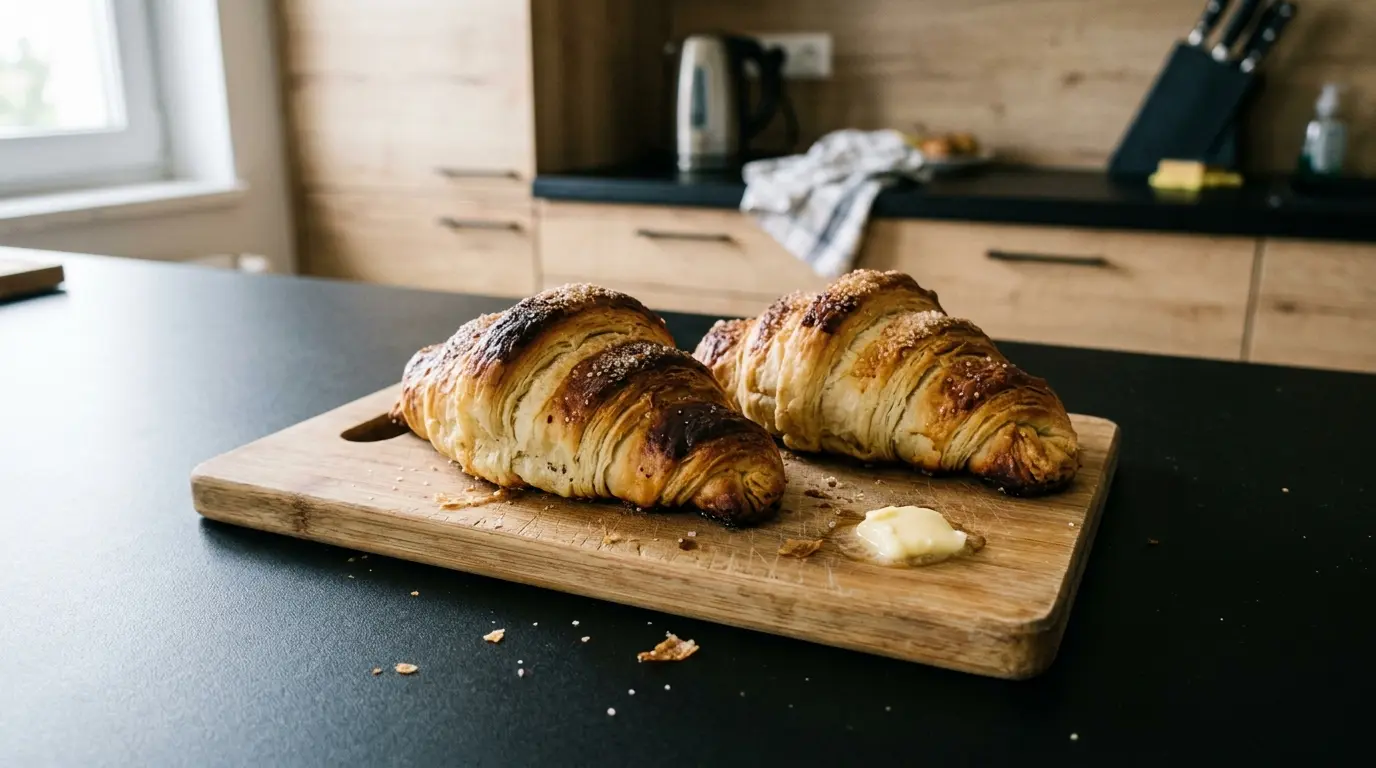
Buttery croissants are light, flaky rolls made from laminated yeast dough, traditionally eaten with coffee in the morning in France. They are soft and delicate inside, slightly crisp on the outside, and smell of butter with a hint of sweetness. It’s a project for a relaxed weekend, but the result is truly impressive.
These croissants are made with a classic laminated yeast dough, giving them a bakery-style flaky texture and rich buttery aroma. The step-by-step folding and chilling process creates distinct layers that puff beautifully in the oven, making them a showstopping homemade breakfast.
Chef's tips
Work with well-chilled butter and dough so the layers don’t melt together. If the dough starts to feel too soft or sticky while rolling, chill it again for 10–15 minutes before continuing. Use a sharp knife or pastry wheel to cut the triangles cleanly, which helps them rise evenly.
How to serve
Serve fresh from the oven or gently rewarmed, with good-quality jam, salted butter, or a slice of cheese. For a French-style breakfast, pair with café au lait or hot chocolate. They also make a great base for sweet or savory fillings, such as ham and cheese or Nutella.
Ingredients
- wheat flour - 500 g
- milk - 250 ml
- yeast - 7 g
- sugar - 50 g
- salt - 8 g
- butter - 40 g
- butter - 250 g
- egg - 1 piece
Preparation
- Mix warm (not hot) milk with sugar and yeast. Set aside for 5–10 minutes, until a light foam appears on the surface.
- Put the flour and salt into a large bowl, add the soft butter and the milk with yeast. Knead by hand or with a dough hook for 8–10 minutes, until the dough is smooth, elastic, and pulls away from the sides of the bowl.
- Shape the dough into a ball, cover the bowl with plastic wrap or a cloth, and leave in a warm place for about 1 hour, until the dough roughly doubles in volume.
- Meanwhile, prepare the butter for laminating: place the cold butter between two sheets of baking paper and roll it out into a rectangle about 15×20 cm. Put it in the fridge so it stays firm but pliable.
- Gently deflate the risen dough by pressing it with your hand, then roll it out into a rectangle about 30×40 cm on a lightly floured surface.
- Place the chilled butter rectangle in the center of the dough. Fold the dough like a letter: first cover the butter with one side of the dough, then with the other, so the butter is completely enclosed inside. Seal the edges.
- Gently roll out the dough with the butter into a rectangle about 25×60 cm, trying not to tear the layers. Fold it into three: first fold one end toward the center, then the other end over the top, like folding a towel. Wrap in plastic wrap and chill in the fridge for 20–30 minutes.
- Take out the dough, turn it 90 degrees, roll it out again into a 25×60 cm rectangle and fold into three once more. Chill in the fridge for another 20–30 minutes. Repeat this process one more time (3 “folds” in total).
- After the final chilling, roll out the dough into a large rectangle about 30×60 cm and about 3–4 mm thick. Using a sharp knife or pastry wheel, cut triangles with a base of about 8–10 cm.
- Gently stretch the base of each triangle, make a small cut in the middle, then roll up toward the tip, forming a croissant shape. Tuck the tip slightly underneath so it doesn’t unroll.
- Place the croissants on a baking tray lined with baking paper, leaving plenty of space between them. Cover loosely with a cloth and leave in a warm place for 1–1.5 hours, until they have clearly risen and feel light.
- Preheat the oven to 200°C (top and bottom heat). Beat the egg with 1 tablespoon of water and gently brush it over the tops of the croissants.
- Bake the croissants for 15–20 minutes, until they rise well and turn a deep golden brown. After removing from the oven, transfer to a rack to cool slightly.
- Store in a paper bag or under a cloth so they don’t soften too much as they would in plastic.
- Serve slightly warm, on their own or with jam, honey, or a piece of cheese. They go perfectly with milky coffee or hot chocolate.
- Before rolling, you can place a piece of chocolate at the base of each triangle for a chocolate version.
- Sprinkle the tops with almond flakes just before baking.
- Add a little grated lemon zest to the dough for a delicate aroma.
Storage
No storage information available for this dish.
Homemade croissants require a bit of time and patience, but most of it is resting time for the dough. Once you go through the process once or twice, it becomes surprisingly straightforward—and the satisfaction of pulling a tray of golden, flaky croissants from your own oven is hard to beat.